Work Un-United Nations Headquarters | vision | design

Research

Type: research and design
Function: counterpart to the UN Headquarters
Location: Sevastopol, Crimea, Ukraine
Year: 2018

The project examines the new opportunities emerging within the interlocking realms of politics and architecture. It explores the role architecture can play in absorbing conflict situations in a divided society. Not by aiming for a consensus but through mutual understanding for different world views.

The growth of the European Union and the ambitions of the Russian Federation have plunged the Crimean Peninsula into the greatest geopolitical crisis since the Cold War. The ensuing socio-political upheavals set the stage for a research project close to my origins and inner world. Could Crimea, instead of being a zone of avoidance it is now, become a driving force for the conflicting systems?
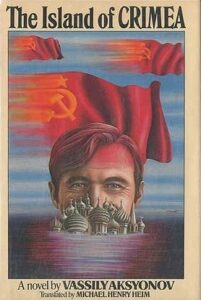
“Aksyonov’s Crimean utopia was a fantasy, but somehow this island was able to build relations with both Soviet Russia and the Western world.”

Written in 1979, Vassily Aksyonov’s “The Island of Crimea” imagines an alternative history (abetted by alternative geography—Crimea is a peninsula).

With changes in our societies, media, family culture, educational institutions, economic and political systems have changed and our conflicts in the world political arena. Hugo de Groot was the first to describe the ‘Casus Belli' the act or event that is used to justify war. The assumption, on which the legislation of a war or conflict is based, is that you always can tell good from the bad. Whereas in current conflicts, and probably in all conflicts and in all times, everybody sees themselves as right and the other as wrong, but more and more often conflicts about the land involve not two, but more parties with opposing opinions.

United Headquarters, as a world peacekeeper confirms to have issues meeting demands of contemporary conflicts and changing political landscape, which is why there is a talk about the need for the creation of UN reforms and rapid reaction force.

Though how to act in a conflict situation where there are many opposing definitions of what is good?

Those hierarchical decisions hardly have any impact anymore. If we desire an end to a conflict, we must provide an arena where differences can be confronted.

As our societies transform, our interactions within the world’s political arena also change. Conflicts have become increasingly more complex. They are now more visible than ever, hardly ever just local but nowadays linked directly to global politics. The United Nations, as the world’s peacekeeper, admits failure reacting to the challenge of contemporary conflicts and changes in the political landscape. Hierarchical decisions hardly have any impact anymore. This has lead to talks about the need for UN reforms, and the creation of a rapid reaction force. If we desire an end to a conflict, we must provide a neutral arena for conflict/disagreement.

Historically both trade and conflict have played a large role in creating a cultural exchange and fostering collective knowledge. An archetype, which simultaneously represents dispute, trade and culture, is the Greek Agora. As a combination of Crimean characteristics, a contemporary agora is introduced - a counterpart to the UN Headquarters - Un-United Nations Headquarters. Realizing the impossibility in ‘the political’ of stable (final) unity and the inevitability of potential conflicts, instead of the utopian idea of stability, this project proposes to use a perpetual instability, a constantly renegotiated temporariness. Un-UN is a neutral arena for disagreement, providing ground for the discussion on the morality of the opposed political systems.
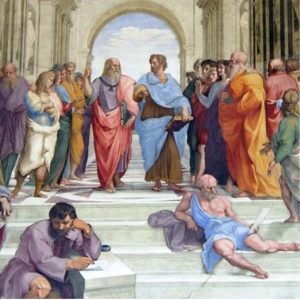
Fruitfulness of conflict: The Greek agon emphasizes the importance of the struggle itself, a struggle that cannot exist without the opponent. Agonism implies deep respect and concern for the other.

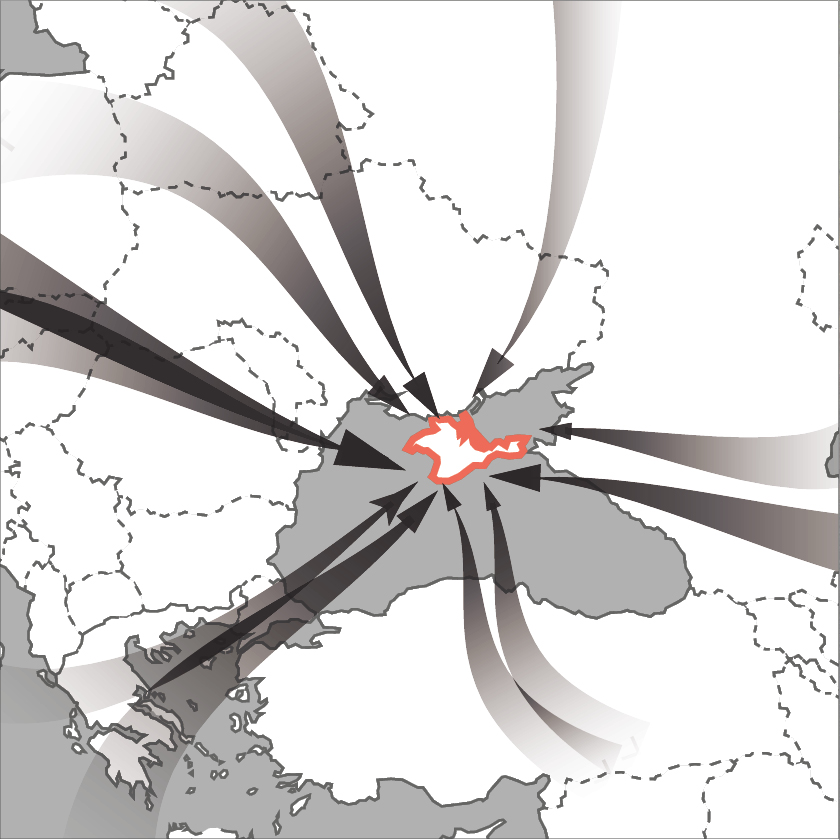
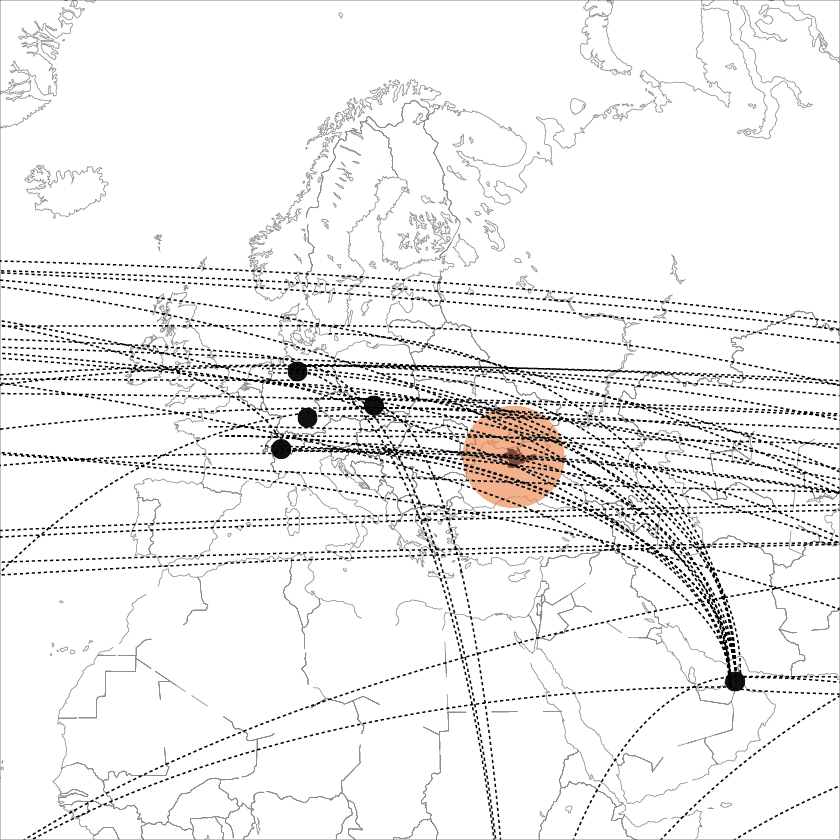
During the historical times Crimea was positioned on the main trade and migration cross-roads from Asia to Europe and From Varagians to the Greeks. Today Crimea is positioned under the busiest air traffic. At the moment there are no international flights from Crimea.
Due to its prosperous geopolitical position, Crimea was always a conflict ground, but also an important link in trade routes.
Un-United-Nations-Headquarters

The project transforms the Sevastopol naval base, the main cause of the conflict, into a trade port, positioning Crimea as the gateway to Ukraine and Russia and as an architectural representation of Crimea’s new identity. The Greek Agora is an archetype that simultaneously represents dispute, trade and culture. As a contemporary agora, the project introduces a counterpart to the UN headquarters, namely the Un-United Nations headquarters. The logic underlying the Un-UN HQ is that an enduring stable unity is impossible in the given situation so that debate is essential. All outcomes of such debate are temporary ‘solutions’, implying that temporariness is a crucial notion. So instead of the Utopian idea of stability, the project proposes a constant instability, a perpetual temporariness of renegotiation.

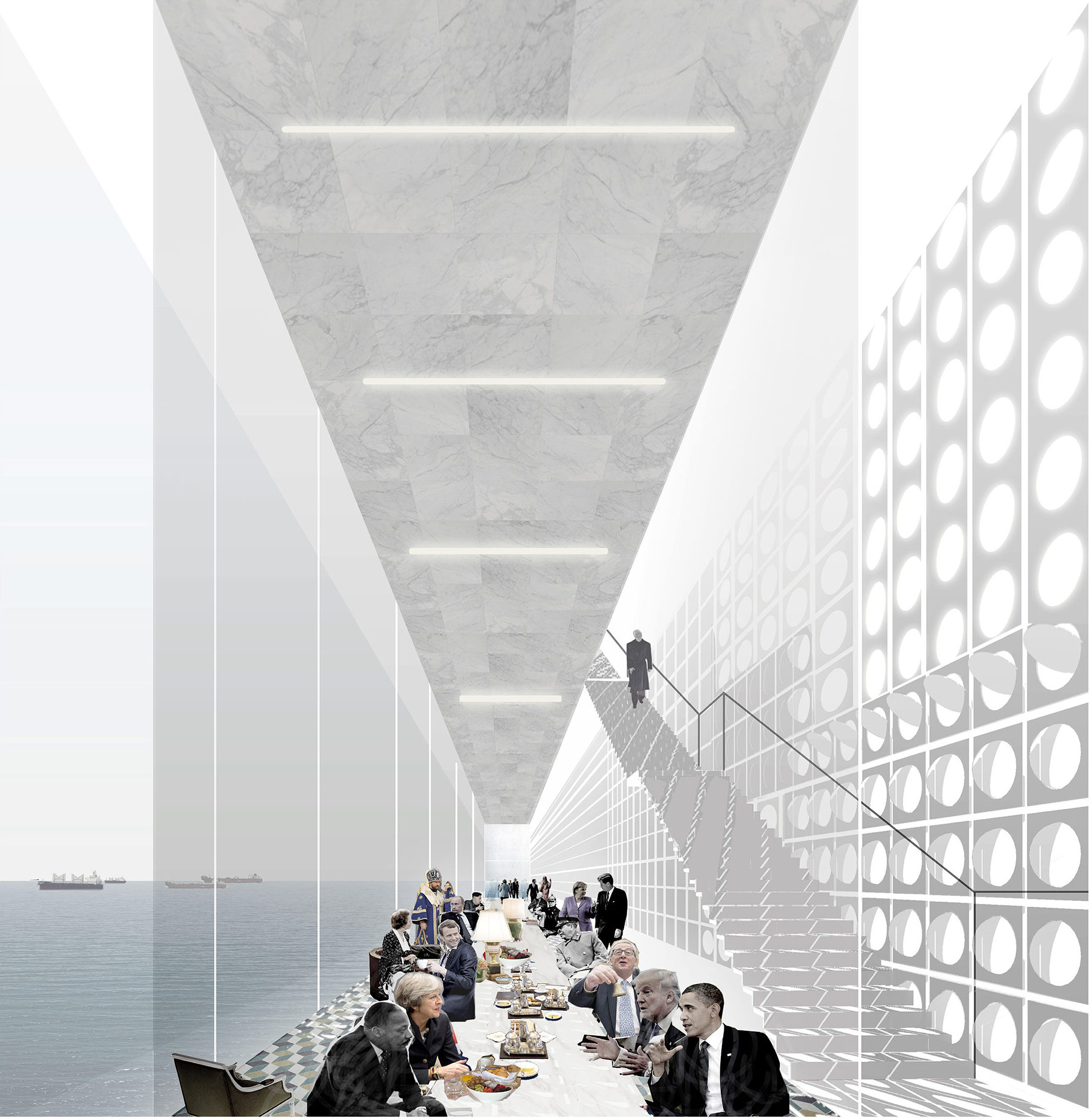
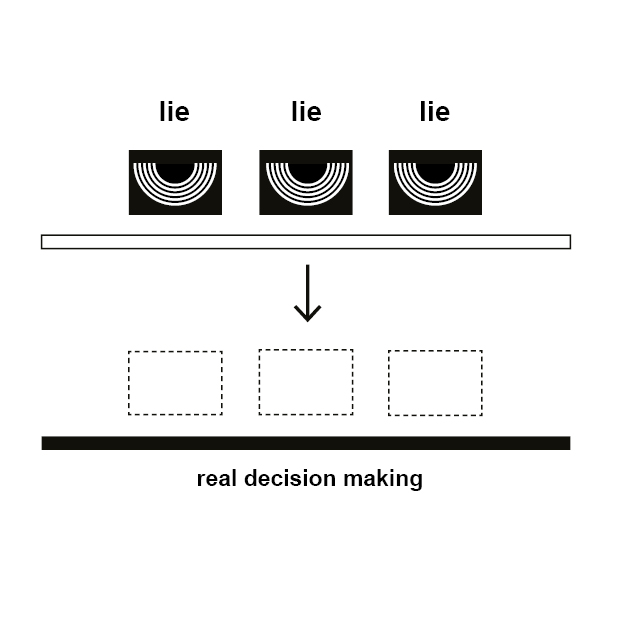
The heart of political institutions, the chamber, has become a decor for rehearsed dialogues, while all meaningful decisions take place in the informal spaces. This project develops this political institution typology using a ‘corridor-only’ model. The corridor is the practical space for negotiation and a symbol of the journey rather than of the destination. Un-UN is a neutral arena for settling disputes, providing ground for the discourse on the morality of opposing political systems.

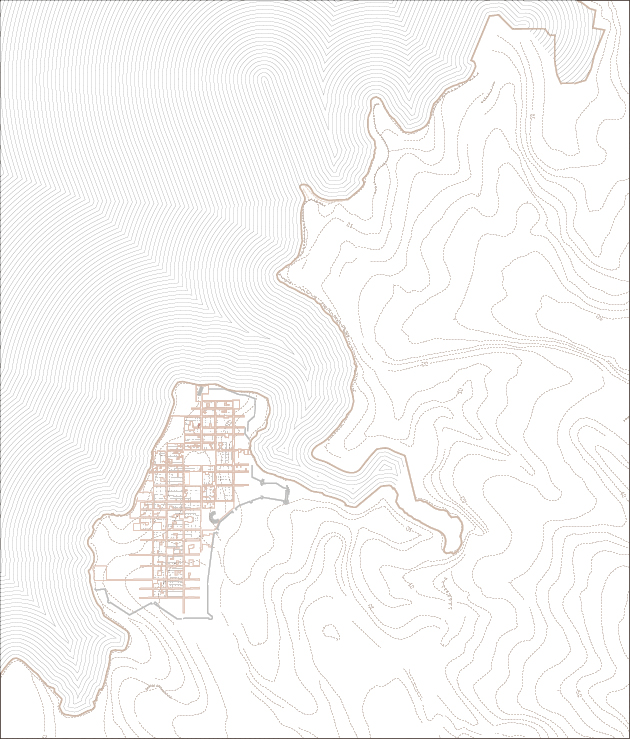
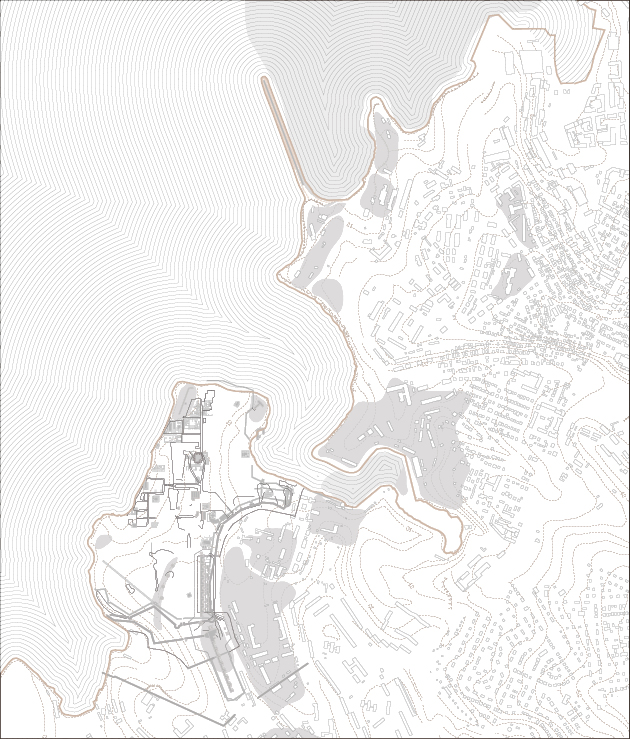
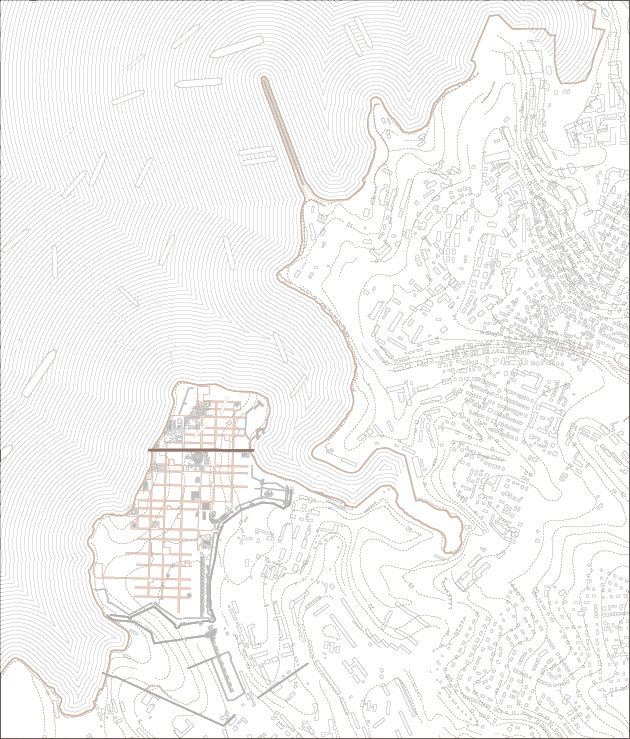
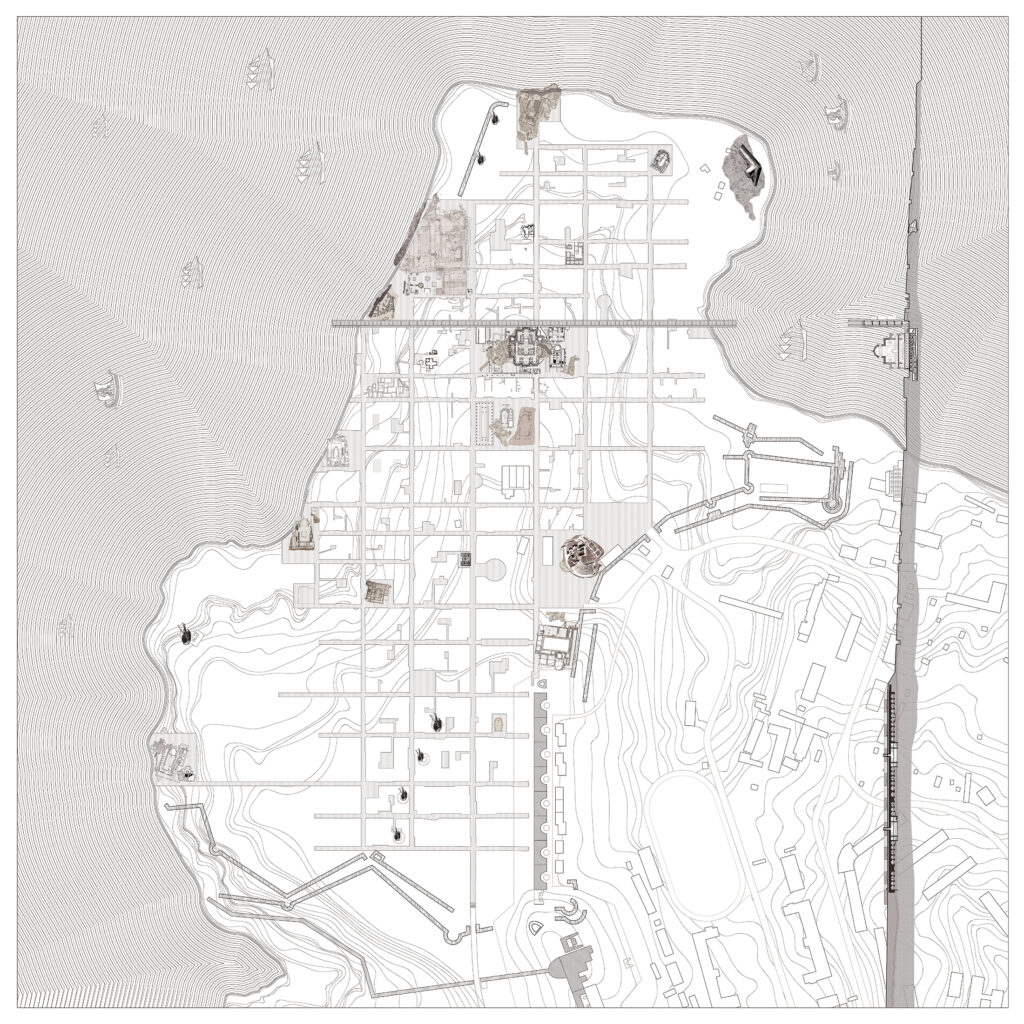
The complex is located next to Sevastopol Bay, an archaeological site based on the ancient Greek city grid. The grounds are filled with solidified architecture whose stratification recalls the political regimes of diverse historical periods and nations. The grid itself has remained intact during the city’s entire existence. Un-UN is positioned within the disclosed grid above an excavated street. As a projection of that street, the vertically organized building portrays a contemporary democratic system superimposed on the historical horizontal layer. In this way, it complements the collection of existing artefacts.

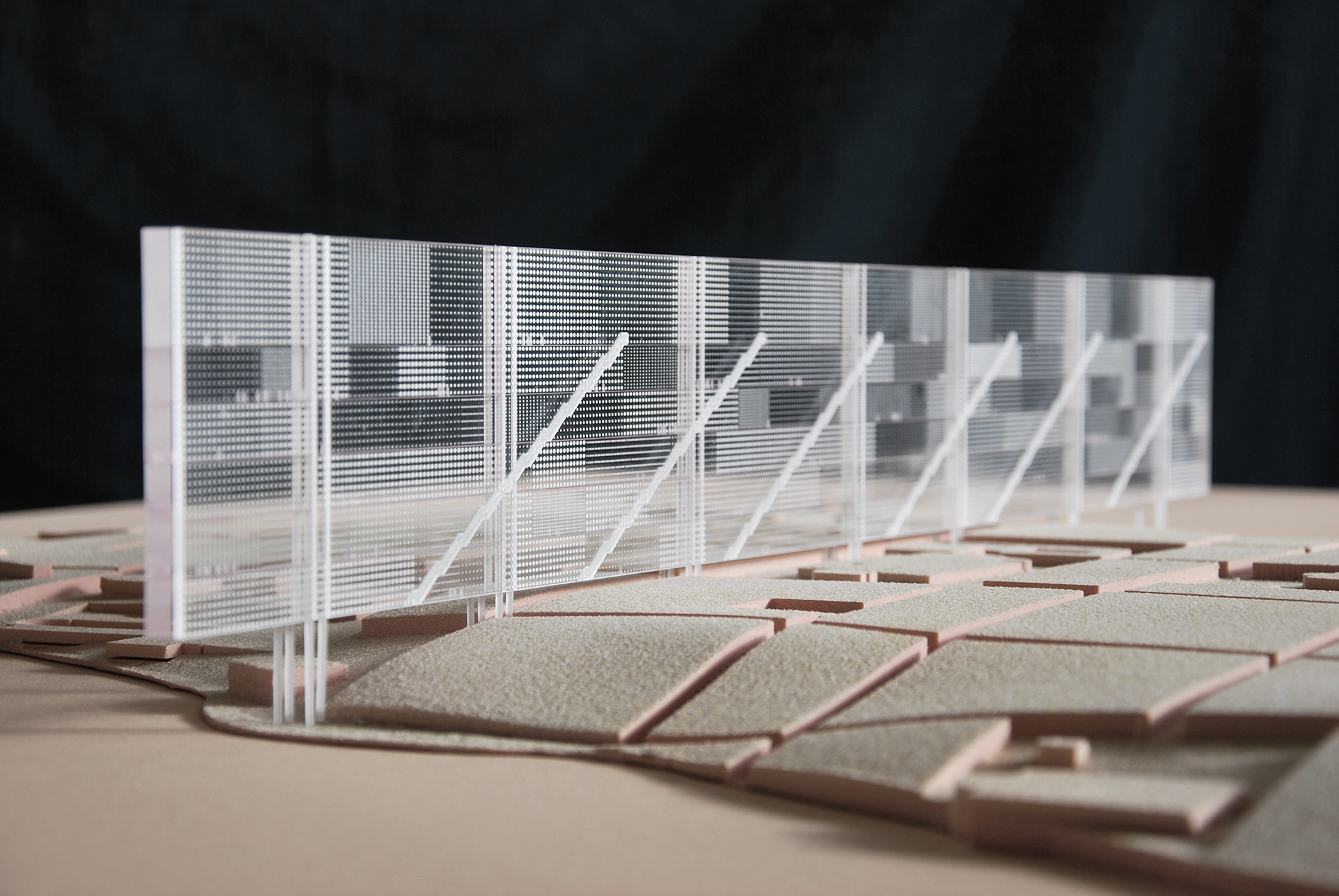
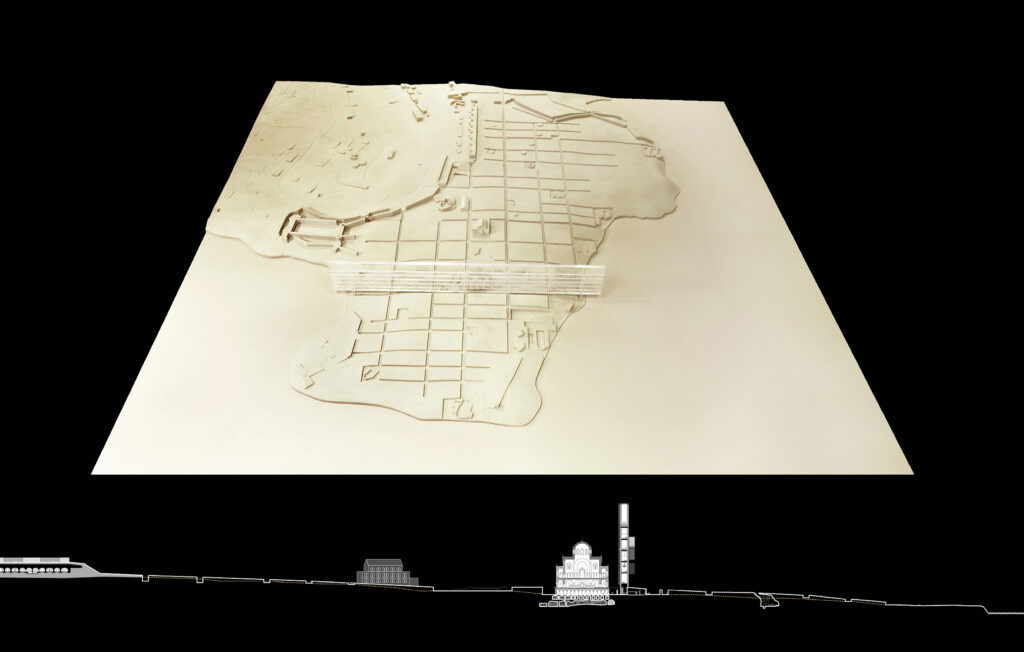
The building acts as a dividing wall but operates as a gateway through its elevated position above the landscape with its passages created by historically exposed connections. This gateway builds relationships with both the Eastern and Western worlds.

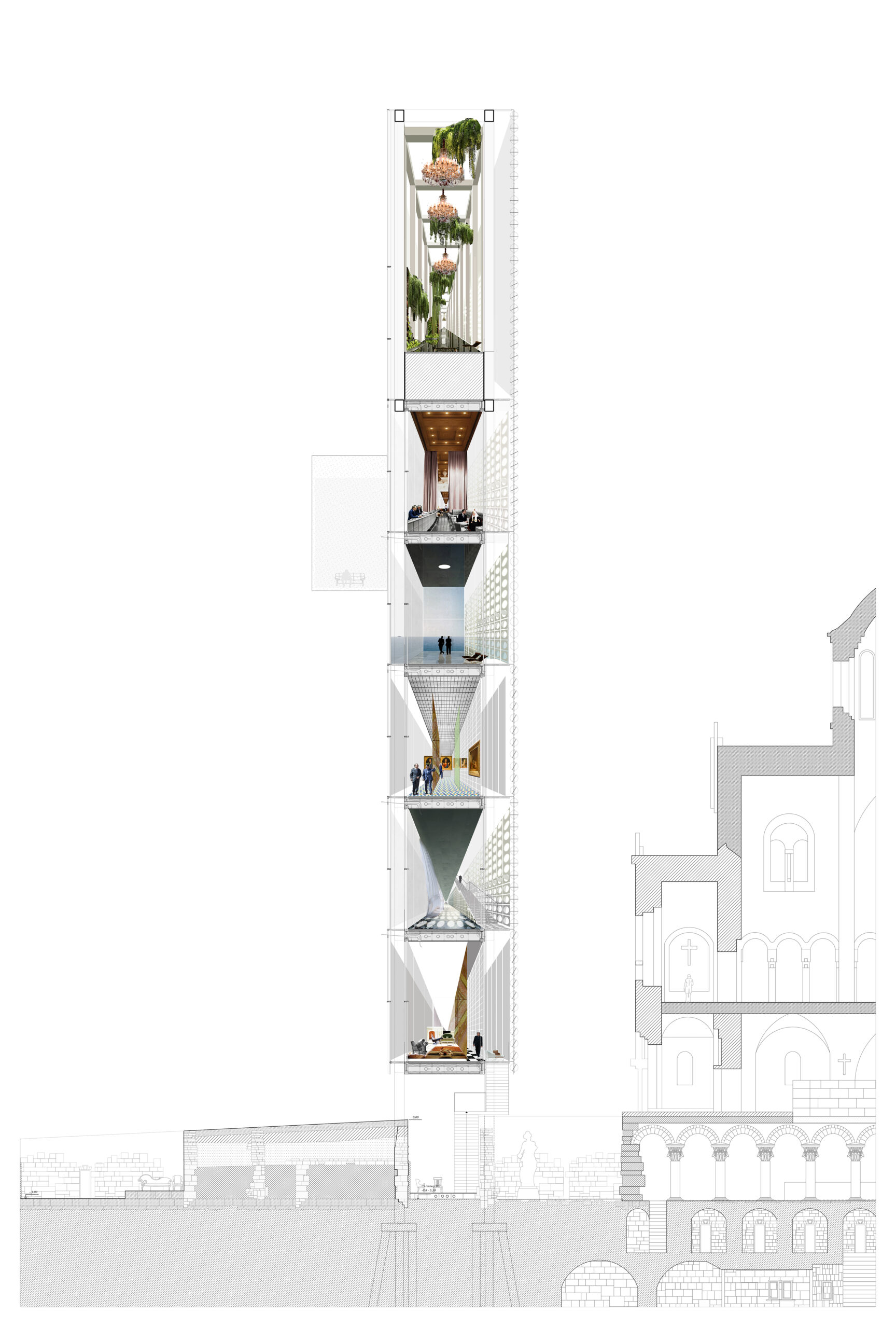
Cross-section of the corridor-only model, the corridor as the infamous domain of informal but real decision-making. Un-United Nations represent a contemporary democratic system, with a vertical order, placed over the historical horizontal one. The building rests within the excavated city grid, where nothing has been constructed before.

Headquarters create a link between the harbor area, the Agora and hovers above the sea, creating views to the incoming ships. From a distance, Un-United Nations performs as a dividing wall. However, it acts as a gate through its elevated position over the landscape and with passageways created by excavated historical links. The building has two different faces. The long side is orientated towards the entrance of the trade port, creating a connection with the city.

Each facade of the building responds to its specific orientation and is based on the climatic conditions.

View of the land. The floor plan offers space for a series of, partly unforeseen, activities. From 24H discussion hall to World Art gallery, world library, spa, twitter chairs, etc. etc.

Linear form allows one to experience the expansive horizon almost continuously.

Movement in the building is always towards the water, while all the discussions are about the land. The structure of the building, its elevators, and its stairs are positioned outside of the corridor in order not to disturb “unlimited thoughts” situated between historical quarters.

South facade changes with weather conditions and functions behind it.

Project

Biography

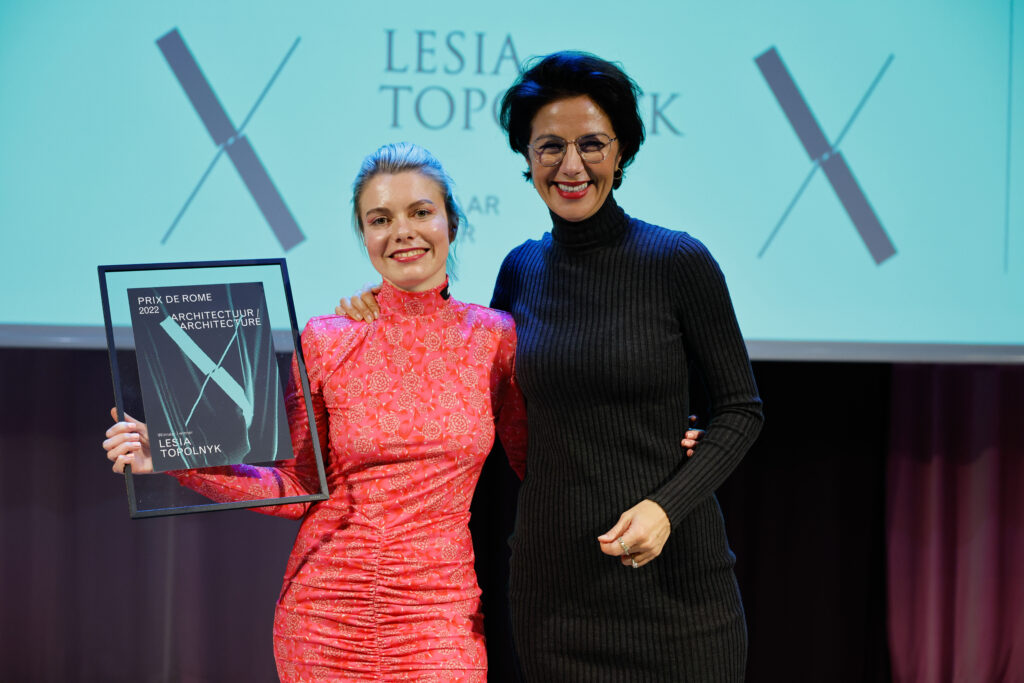
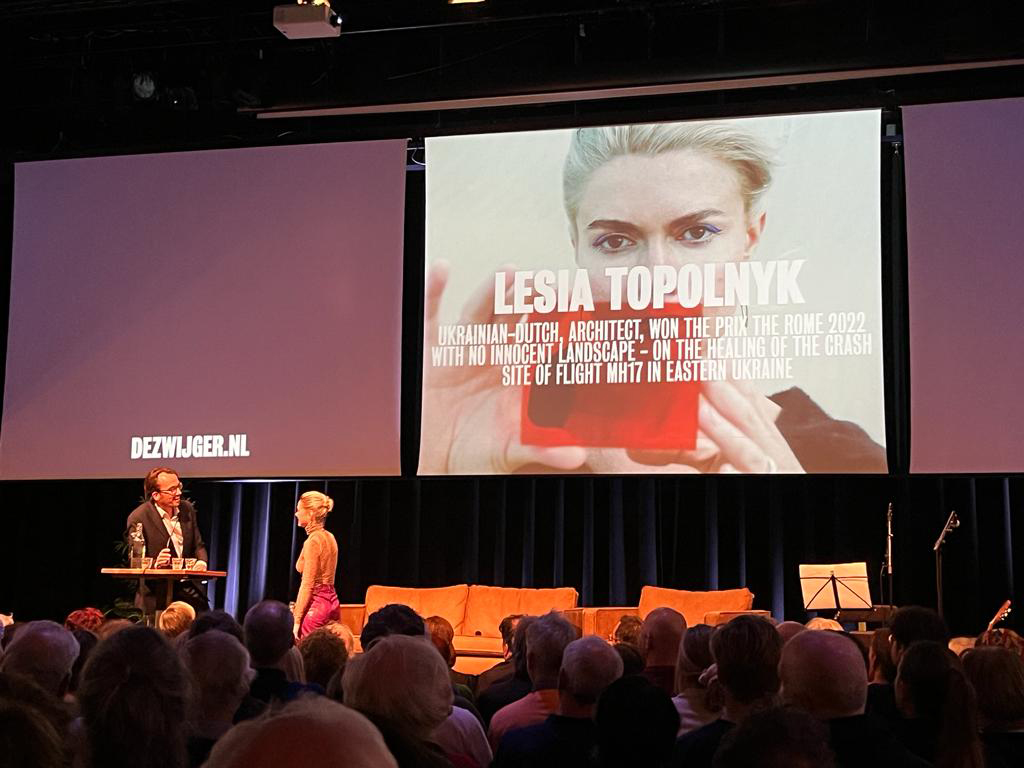
The Prix de Rome is the oldest and most prestigious Dutch award for visual artists and architects below the age of 35.

Lesia's work has been published in ArchDaily, E-Flux, STIRworld, NRC, Het Financieele Dagblad Persoonlijk, Metropolis, Mister Motley, Blauwe Kamer, AD, and more.

Honors & Awards:

2024 - Residency at The Savannah Centre for Contemporary Art (SCCA) and Studio of Ibrahim Mahama (Red Clay), Ghana

2024 - Residency on Governors Island, New York

2023 - IABR Agent of Change

2023 - Financieele Dagblad Top 50 Talent 2023

2022 - Winner Prix de Rome, the Netherlands

2020 - Talent Grant, Creative Industries, Netherlands

2020 - Young Talent Architecture Award, nomination (by the Fundació Mies van der Rohe and the EU Commission)

2019 - Winner Archiprix Nederland

2019 - Winner Archiprix International

2019 - Winner Tamayouz International Award

2014 - AHK Talent Grant

Selected Exhibitions:

2025 - Solo exhibition at MAGAZIN, Vienna, Austria (upcoming)

2025 - Lisbon Architecture Triennale, Portugal

2024 - Work presentation at RedClay (Studio of Ibrahim Mahama), Ghana

2024 - Mobile installation, exhibition, Governors Island - Lower Manhattan, New York

2024 - OMI, "Rotterdam Culture City", alongside significant works by OMA and West 8.

2024 - International Architecture Biennale Rotterdam (IABR)

2022 - Prix de Rome, NI, Rotterdam

2022 - Architecture Triennale, Lisbon

2022 - New European Bauhaus, Brussels

2021 - Dutch Design Week

2021 - Biennale, Venice

2020 - Dutch Design Week

2019 - Biennale, Santiago

2019 - Archiprix International

2019 - Archiprix Netherlands

Portrait for Prix de Rome 2022

Lesia Topolnyk is a licensed architect and recipient of numerous Dutch and international awards for design and research — including the Prix de Rome and Archiprix. Named an agent of change by the International Architecture Biannale Rotterdam for her work on energy transition and places that require a new vision, she brings more than ten years of experience working at internationally acclaimed Dutch practices. Her projects span the Netherlands, New York, North Africa, and her native Ukraine.

Her practice operates across two registers: spatial design — buildings, interventions, interiors — and strategic research consultancy for municipalities, developers, and NGOs engaged with transition themes including energy, landscape, and heritage. The two are not separate disciplines but a single sensibility applied at different scales and in different forms of collaboration. Her work does not stop at the building — it contributes to the shaping of the spaces and systems we inhabit.

About / Contact